Is Your Apartment Actually Secure? What Every Renter Should Know in 2026
Choosing the right apartment security system is one of the most important decisions a renter can make — yet most people put it off until something goes wrong.
Here’s a quick comparison to help you find the right fit fast:
| Security Option | Best For | Installation | Monthly Cost |
|---|---|---|---|
| DIY wireless system | Most renters | Self-install, no drilling | $0–$33+ |
| Professionally monitored system | Renters wanting 24/7 response | DIY or pro install | $20–$50 |
| Camera-only setup | Budget-conscious renters | Plug-in or adhesive | $0–$20 |
| Smart lock + sensor bundle | Tech-savvy renters | Adhesive/screw optional | $0–$25 |
The reality is that renters face a unique set of security challenges. Landlords often restrict permanent modifications, which rules out most traditional alarm systems. And building security — cameras in the lobby, a coded gate — only covers shared spaces. What happens inside your unit is entirely up to you.
More than 80% of property managers believe crime rates in multi-family dwellings are rising. And with 57% of burglaries involving forcible entry, simply hoping for the best is not a strategy.
The good news? Modern apartment security systems are designed specifically for renters. Wireless sensors, peel-and-stick mounts, and no-contract monitoring plans mean you can protect your home without damaging walls or risking your security deposit.
This guide compares your best options in 2026 — so you can make a confident, informed choice.
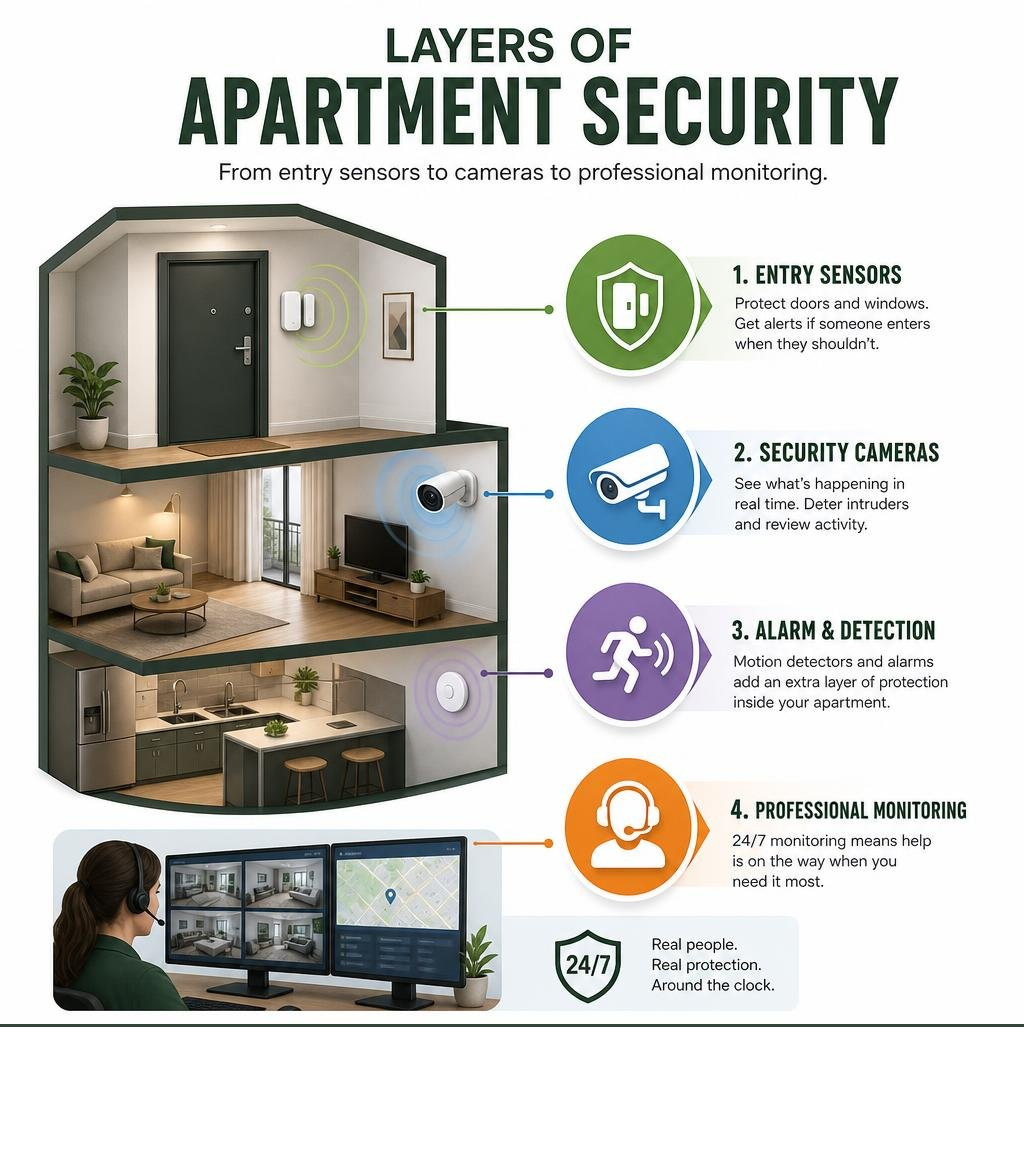
Essential apartment security system terms:
Why Every Renter Needs an Apartment Security System

When you lease an apartment in beautiful coastal spots like Burleigh, Elanora, or Tugan, it is easy to let your guard down. We often assume that living on the second floor or having a security door at the main entrance of our building makes us safe. However, statistics paint a different picture. Multi-family housing structures are frequently targeted by opportunistic thieves because of the high volume of people coming and going.
With more than 80% of property managers reporting an uptick in crime rates within multi-family complexes, having a dedicated security system inside your actual rental unit is no longer a luxury—it is a necessity.
A standard building intercom or security gate only controls the perimeter. Once an intruder slips past the front gate (often by simply tailgating another resident’s car), they have unrestricted access to your front door. Since 57% of burglaries involve forcible entry, relying solely on your landlord’s basic lock is a major risk.
Furthermore, package theft has skyrocketed. Delivery drivers frequently leave parcels in communal hallways or lobby areas where anyone can walk off with them. By installing a smart doorbell or an indoor camera pointed at your entryway, you can monitor deliveries in real-time and prevent “porch pirates” from ruining your week.
An apartment security system is about protecting your peace of mind and your physical safety. Whether you live alone in a cosy studio in Miami or share a larger flat with roommates in Tweed, knowing that your entry points are monitored 24/7 allows you to sleep soundly and enjoy our coastal lifestyle to the fullest.
Choosing the Right Apartment Security System: Key Features to Look For

Not all security systems are built equal, and what works beautifully for a sprawling five-bedroom house in the suburbs might be completely impractical for a rental unit. When you are shopping for an apartment security system, there are several key features you must prioritize to ensure the setup is renter-safe and highly effective.
First and foremost is wireless connectivity. Traditional security setups rely on running cables through walls and drilling deep into studs. For renters, this is a fast track to losing your bond. Wireless systems use Wi-Fi or cellular networks to communicate, allowing you to place sensors on doors, windows, and walls using non-damaging adhesive tape.
Second, look for a system with a reliable battery backup. If there is a power outage or a storm rolling through Northern NSW, you do not want your home security to go dark. Most high-quality hubs feature a backup battery that keeps the system running for up to 24 hours without mains power. Some even include cellular backup, meaning the system can still send alerts to your phone even if your home Wi-Fi goes down.
Third, if you share your home with a four-legged friend, you must ensure the system features pet-friendly motion sensors. Older motion detectors would trigger an alarm every time a cat jumped onto the kitchen counter or a dog trotted across the living room. Modern smart sensors are designed to ignore movement from animals under 22 kg (50 lbs), saving you from heart-stopping false alarms while you are at work.
Finally, seamless smart home integration is a massive bonus. Your security system should play nicely with your existing tech, whether you use Amazon Alexa, Google Assistant, or Apple HomeKit. This allows you to arm your system with a quick voice command on your way out the door or integrate your security sensors with your smart lighting. For a deeper look at what is possible with modern security tech, check out our A Comprehensive Guide to Security System Upgrades.
DIY vs. Professional Installation for Your Apartment Security System
One of the biggest decisions you will face is whether to install the system yourself or hire a professional. For renters, DIY installation is incredibly popular because it usually involves peel-and-stick sensors and zero-damage removal. You can unbox a DIY kit, stick the contact sensors on your doorframes, place an indoor camera on a bookshelf, and have the entire system up and running in under 30 minutes without picking up a drill.
However, professional installation still has its place, especially if you want to integrate high-end hardware like smart locks or complex CCTV networks. If you do choose a professional route, always check your lease agreement first. Most landlords are happy to approve security upgrades as long as they do not damage the property. If you want to take your physical security to the next level by upgrading your front door lock, read our guide on How to Install a Smart Lock the Right Way to ensure you stay on your landlord’s good side.
If you are located in Northern NSW or the southern Gold Coast, you can also explore local professional services like Security Cameras Tweed – Sales & Installation – In Connect or check out local installation options such as Local Security in Currumbin | Installation and repairs – Fallon Solutions to see how professional technicians handle non-invasive setups in your neighborhood.
Is a Self-Monitored Apartment Security System Right for You?
Once your hardware is in place, you need to decide how your system will be monitored. You have two main routes: self-monitoring or professional monitoring.
- Self-Monitoring: With this option, there are usually no monthly subscription fees. When a sensor is triggered, the system sends a push notification directly to your smartphone via a mobile app. It is up to you to check the live camera feed, determine if there is an actual emergency, and call the police if necessary. This is highly budget-friendly but relies entirely on you having your phone on, being in cellular range, and not being asleep or in a meeting when an alert comes through.
- Professional Monitoring: For a monthly fee (typically ranging from $20 to $50 depending on the provider), a professional monitoring centre watches over your system 24/7. If an alarm triggers and you do not disarm it, a trained dispatcher will attempt to contact you. If they cannot reach you or if video verification confirms an intruder, they will immediately dispatch emergency services.
If you are weighing up whether the extra monthly cost is worth it for your peace of mind, you can dive deeper into the pros and cons in our article Safe and Sound: A Comprehensive Home Security System Review for 2026.
Comparing Renter-Friendly Security Options in 2026
As we navigate 2026, the market is flooded with fantastic, renter-friendly security systems. Let’s look at how the top options stack up for apartment living:
| Brand / System | Best Known For | Key Renter Feature | Typical Monitoring Cost |
|---|---|---|---|
| SimpliSafe | Best overall renter system | Easy peel-and-stick, no contracts | From $19.99 to $32.99/mo |
| Wyze | Best budget camera bundles | MicroSD local recording, ultra-affordable | $0 (Self-monitored) or low-cost plans |
| Reolink | Best subscription-free video | High-res local storage, no monthly fees required | $0 (Self-monitored) |
| Cove | Best affordable pro monitoring | Portable touchscreen panel, fast dispatch | Starts at $19.99/mo |
| Roombanker | Best smart apartment integration | Multi-system automation, wireless RBF tech | $0 (Self-monitored) |
If you are looking for a complete, out-of-the-box camera bundle that requires zero drilling, the Apartment Plus Kit is an exceptional starting point. It offers a battery-powered video doorbell and pan-and-tilt indoor cameras that can track motion automatically—perfect for keeping an eye on your living room and front door without running a single wire.
For those who want a highly customizable, wireless setup that combines intrusion alarms with smart home automation, the Wireless Apartment Security System, Home Security & Alarm For Apartment | Roombanker offers incredible flexibility. It uses ultra-long-range wireless technology so you can place sensors anywhere in your flat, and it even offers environmental monitoring (like water leak detection) to protect your rental from accidental flooding.
If video quality and local storage are your top priorities, the Apartment Security System | Reolink Video System for Apartment is hard to beat. These systems allow you to record continuously to a local microSD card, completely eliminating the need for a monthly cloud subscription while still giving you high-definition live feeds and instant alerts on your phone.
For renters who want a deeply integrated smart apartment experience, platforms like Smart Home for Multifamily: Resident Value + NOI | iApartments are changing the game. Many modern apartment buildings now come pre-installed with these enterprise-grade smart home hubs, allowing tenants to control locks, lighting, and climate control directly from a single app.
To see a comprehensive breakdown of how these and other top-tier systems perform in real-world testing, you can read the full Best Security Systems for Apartments & Renters in 2026 review.
Debunking Common Myths About Rental Security
There are several persistent myths that prevent renters from securing their homes. Let’s clear the air and look at the facts:
- Myth 1: “My building has secure access, so I don’t need an alarm.”
- The Reality: Lobby cameras and intercoms are excellent deterrents, but they are easily bypassed. Food delivery drivers, tradespeople, and visitors constantly tailgated residents through secure gates. Once someone is inside the corridors, your front door is the only line of defense.
- Myth 2: “Security systems are only for homeowners.”
- The Reality: This might have been true a decade ago when alarms required professional hardwiring, but the security landscape of 2026 is built around renters. Modern systems are completely portable, wireless, and contract-free.
- Myth 3: “My landlord is responsible if my apartment gets broken into.”
- The Reality: Legally, your landlord is only required to provide working locks on doors and windows. They are not responsible for your personal belongings. If a break-in occurs, your landlord’s insurance covers the physical building, but you need renters insurance (and ideally a security system) to protect your own valuables.
- Myth 4: “A security system will cause constant false alarms and get me fined.”
- The Reality: Modern motion sensors are incredibly sophisticated. With pet-immunity settings and adjustable sensitivity levels, false alarms are rare. Plus, many systems now feature video verification, meaning monitoring agents can look at a live feed to confirm an intruder before alerting emergency services.
Frequently Asked Questions about Apartment Security
Can I install a security system without violating my lease?
Yes, absolutely! The vast majority of modern DIY security systems are designed specifically to be lease-friendly. Because they use non-invasive adhesive mounts instead of screws, they leave absolutely no marks, holes, or damage on the walls when it is time to move out.
However, we always recommend double-checking your tenancy agreement. If you want to install a smart lock or a video doorbell that replaces existing hardware, you should get written permission from your landlord first. For a list of the easiest, most rental-friendly options on the market, check out our guide on Alarming Simplicity: The Best Easy to Install Security Systems.
What happens to my security system when I move?
One of the greatest benefits of a wireless apartment security system is its complete portability. When your lease ends, you simply peel the sensors off the doors and windows, pack the hub and cameras into a box, and take them to your new home.
Most DIY brands even offer “move assistants” in their mobile apps, helping you easily reconfigure your existing sensors to match the floor plan of your new apartment. To help you plan your next move and compare how different systems handle relocation, take a look at our Ultimate Checklist for Comparing Home Security Systems.
How much does an apartment security system cost?
The cost of securing your apartment can vary widely depending on your needs:
- Entry-Level (Self-Monitored): You can purchase a basic starter kit (a hub, a door sensor, and an indoor camera) for around $100 to $150 with $0 ongoing monthly fees if you choose to self-monitor.
- Mid-Range (With Professional Monitoring): A comprehensive hardware kit (multiple entry sensors, motion detectors, and a keypad) will cost between $200 and $300 upfront, with professional monitoring subscriptions ranging from $20 to $35 per month.
- Premium Systems: If you want multiple outdoor/indoor cameras, smart locks, and environmental sensors, upfront equipment costs can reach $500+, with monitoring plans around $40 to $50 per month.
Conclusion
Securing your rental property does not have to mean risking your bond or breaking the bank. With the incredible range of wireless, damage-free, and highly portable apartment security systems available in 2026, you can easily customise a setup that perfectly matches your lifestyle and budget.
While DIY wireless kits are fantastic for quick, non-invasive setups, some security upgrades—like high-quality deadbolts, smart lock integrations, and advanced security door servicing—benefit immensely from a professional touch.
At Palm Beach Locksmiths, we have been helping residents secure their homes across the Gold Coast, Tweed, Currumbin, Burleigh, Elanora, Tugan, and Northern NSW for over 40 years. Whether you need emergency lockout assistance, a physical lock upgrade that complies with your tenancy agreement, or expert advice on the best electronic security for your rental, our 24/7 mobile team is always here to help.
Ready to take your apartment’s physical security to the next level? Secure your Gold Coast apartment with expert CCTV camera installation or get in touch with our friendly team today to discuss how we can help you protect what matters most.