
Why the Right Commercial Locks Near Me Matter More Than You Think
When you’re searching for commercial locks near me, the stakes are higher than most business owners realize. Commercial properties experience 2.5 times more break-ins than residential properties each year — and over 60% of those break-ins happen through doors fitted with outdated or standard-grade locks.
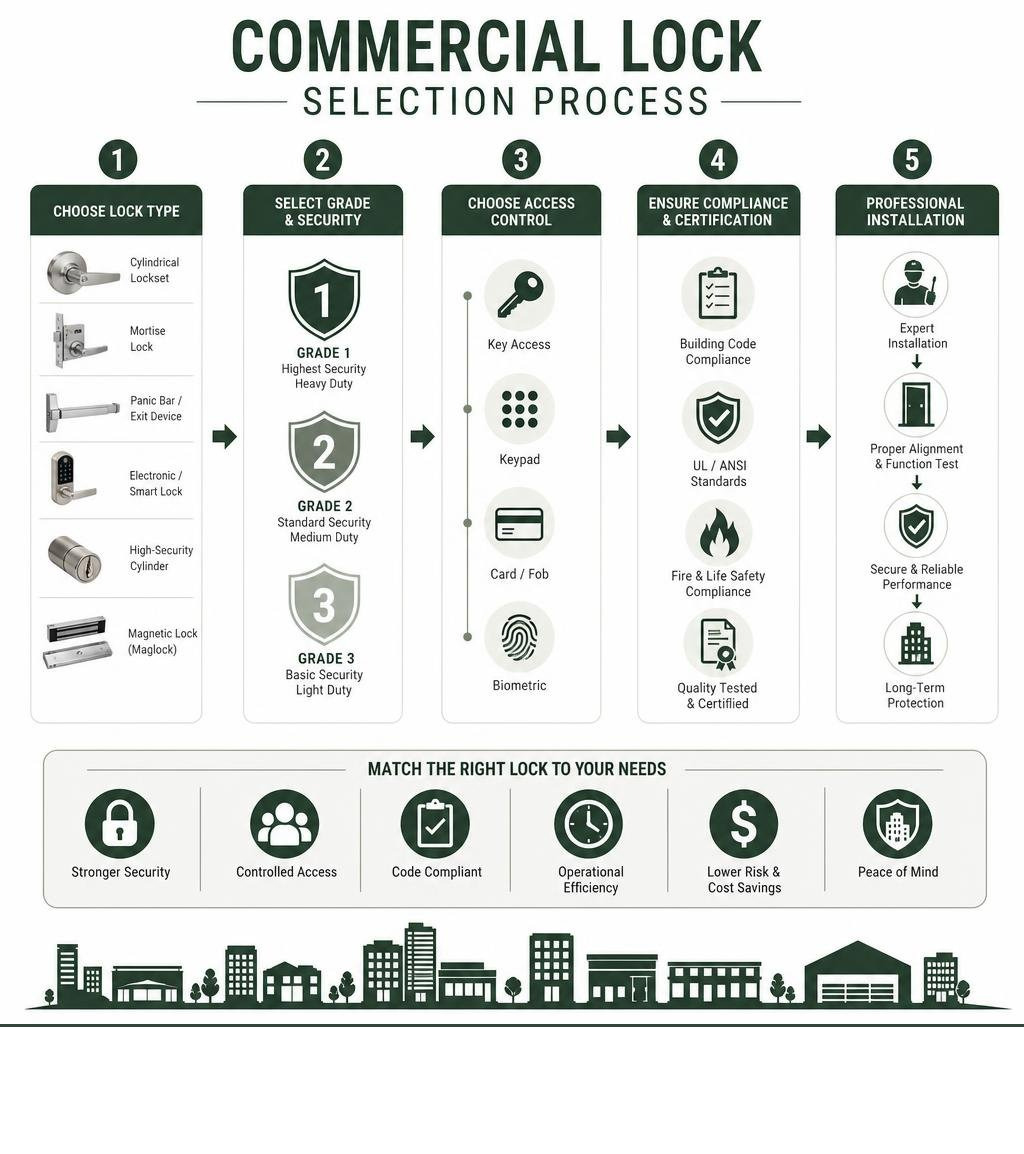
Here are the most common commercial lock types to compare:
| Lock Type | Best For | Security Level | Access Control |
|---|---|---|---|
| Cylindrical Lockset | Small offices, interior doors | Grade 2-3 | Key or keypad |
| Mortise Lock | High-traffic entrances | Grade 1 | Key, card, or keypad |
| Panic Bar / Exit Device | Fire egress doors | Grade 1 | Exit only |
| Electronic / Smart Lock | Multi-staff access management | Grade 1 | Card, fob, biometric |
| High-Security Cylinder | Sensitive zones, server rooms | UL437 rated | Restricted key |
| Magnetic Lock (Maglock) | Controlled entry doors | Grade 1 | Card, fob, keypad |
Choosing the wrong lock isn’t just a security risk — it can mean non-compliance with building codes, costly rekeying after staff turnover, or being locked out of your own premises at the worst possible moment.
The good news: upgrading to the right commercial hardware can reduce unauthorized access incidents by up to 70%, and businesses using electronic access control report a 40% drop in employee-related security breaches.
This guide walks you through every major hardware type, what to look for in grades and certifications, and how to match the right system to your specific business.
Discover more about commercial locks near me:
Understanding Commercial Locks Near Me: Grades and Standards
When searching for commercial locks, you will quickly notice that commercial hardware is rated differently than residential locks. The Builders Hardware Manufacturers Association (BHMA) and the American National Standards Institute (ANSI) categorize locks into three distinct grades based on durability, security, and cycle testing.
| ANSI/BHMA Grade | Durability (Cycles) | Intended Use | Security Level |
|---|---|---|---|
| Grade 1 | 1,000,000+ cycles | Heavy-duty commercial, main entries, schools, hospitals | Highest |
| Grade 2 | 800,000 cycles | Standard commercial, interior offices, light-duty entry | Medium |
| Grade 3 | 400,000 cycles | Residential, light-duty commercial utility closets | Basic |
For any commercial storefront or main entry point in high-traffic commercial zones like Burleigh or Tweed, Grade 1 hardware is the absolute standard. Installing anything less is an open invitation for early mechanical failure and security vulnerabilities.
Beyond ANSI grades, look for UL437 certification. This is the gold standard for high-security lock cylinders. A UL437-rated lock has undergone rigorous testing to prove it can resist physical attacks, including drilling, picking, prying, and pulling.
If your existing commercial locks are showing signs of wear, or if you have recently taken over a new commercial space in Elanora or Tugun, it is highly recommended to schedule professional lock replacement services to ensure your business meets modern security expectations.
Types of Commercial Lock Hardware and Security Systems
Securing a business requires a layered approach. The door hardware you choose must integrate seamlessly with your daily operations, employee workflows, and emergency egress protocols.
Mortise Locks vs. Cylindrical Commercial Locks Near Me
Two of the most common mechanical locks found on commercial doors are mortise locks and cylindrical locks. Understanding the differences between them is crucial when planning a hardware upgrade.
- Mortise Locksets: A mortise lock requires a rectangular pocket (the mortise) to be carved directly into the edge of the door. This design houses a heavy-duty chassis, incorporating both a robust latchbolt and an integrated deadbolt. Because the lock is housed within the door itself, mortise locks offer superior resistance to physical attacks. They are ideal for high-traffic external doors and sensitive areas.
- Cylindrical Locks: These locks are installed through a bored hole in the face of the door. While easier and faster to install than mortise locks, standard cylindrical locks do not offer the same level of physical shear resistance. They are best suited for interior office doors, storage closets, and secondary exits.
The transition to Grade 1 mortise locksets is universally recommended for external storefronts to ensure maximum physical security and durability.
Panic Bars, Exit Devices, and Fire-Rated Hardware
Life safety and emergency egress are paramount for any commercial building. In an emergency, occupants must be able to exit the building instantly without needing a key, tool, or special knowledge. This is where panic bars (also known as crash bars or exit devices) come into play.
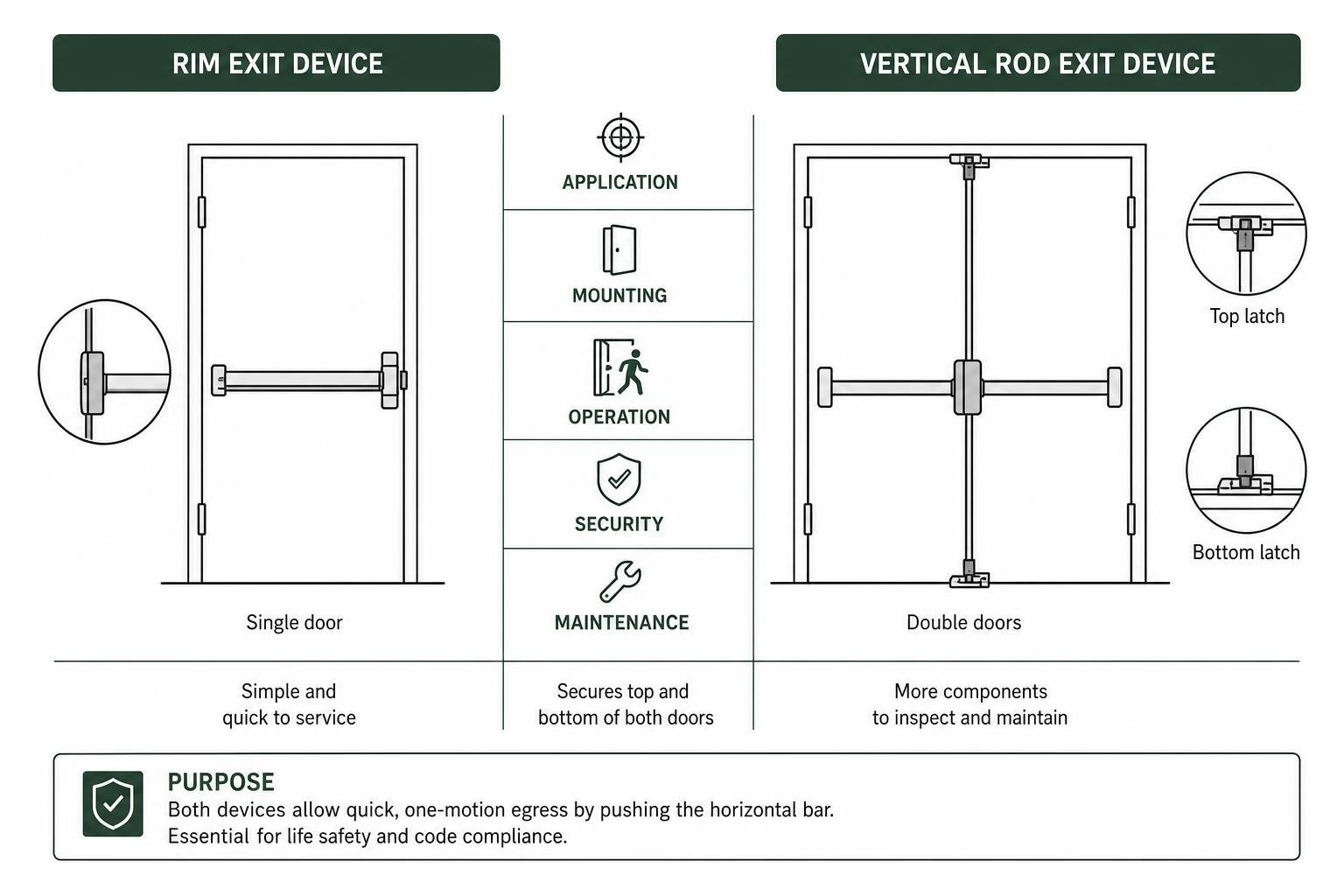
Panic hardware is designed so that simple body pressure against the horizontal bar unlocks the door for egress. Depending on your building design, you may require:
- Rim Exit Devices: Mounted on the inside surface of single doors.
- Vertical Rod Devices: Securing double doors at both the top and bottom frames.
In regions like the Gold Coast and Northern NSW, commercial doors must comply with strictly enforced building codes (such as AS1905 for fire doors and AS1428 for access and mobility). Non-compliant hardware can result in heavy fines during fire marshal inspections. Furthermore, worn-out exit hardware can cause doors to sag or fail to latch. If you are experiencing issues with heavy storefront doors in Currumbin or Miami, professional commercial door repairs will ensure your exit pathways remain safe, secure, and fully compliant.
Electronic Access Control and Smart Commercial Locks Near Me
The commercial security landscape in 2026 is rapidly moving away from traditional mechanical keys. Modern businesses require flexible, traceable, and scalable solutions.
Upgrading to modern access control systems provides a host of operational advantages:
- Keyless Entry: Employees use proximity cards, key fobs, PIN codes, or smartphone credentials to unlock doors.
- Audit Trails: Access control software tracks exactly who entered which door, and at what time. This is invaluable for retail pharmacies, medical clinics, and professional offices handling sensitive data.
- Remote Management: If an employee leaves the company, their digital credential can be deactivated instantly with a few clicks, eliminating the need to physically rekey the building.
- Scheduled Locking: Program your main entrance to automatically unlock during business hours and lock down at close.
Modern commercial operations rely on smart integration to keep their assets secure, combining physical strength with digital flexibility to protect sensitive areas.
Key Management: Master Key Systems and Restricted Keyways
If your business relies on mechanical locks, managing dozens of individual keys can quickly become an administrative nightmare. A master key system offers a structured, secure, and highly convenient alternative.
In a master key hierarchy, keys are cut to operate on tiered levels:
- Great Grand Master / Grand Master Key: Opens every lock across multiple buildings or departments.
- Master Key: Opens all locks within a specific department or floor.
- Change Key (User Key): Only opens one specific door (e.g., an individual employee’s office).
To ensure your master key system remains secure, it should be built on a restricted keyway. Standard keys can be duplicated at any local hardware store or automated kiosk without your knowledge. Restricted keys, however, use patent-protected key blanks that can only be duplicated by the authorized locksmith who designed the system, and only when requested by an authorized signatory.
Implementing a restricted master key system is one of the most cost-effective ways to give your business a modern security makeover, preventing unauthorized key duplication and maintaining absolute control over who has access to your premises.
Frequently Asked Questions about Commercial Locks
How much does professional commercial lock installation cost?
Commercial lock installation costs vary based on the complexity of the hardware, the door material (aluminum, timber, or hollow metal), and whether structural modifications are required.
- Commercial Lockout Services: Typically range from $125 to $225 during standard business hours, with after-hours or emergency rates ranging from $200 to $350.
- Employee Turnover Rekeying: Standard rekeying costs between $45 and $75 per cylinder.
- Master Key System Design: A basic master key system (5 to 15 doors) typically ranges from $450 to $1,200.
- Electronic Access Control: Standalone smart locks or single-door access control installations generally run from $550 to $1,250 per door.
Investing in professional installation ensures your hardware operates smoothly and does not void manufacturer warranties, which can range from 1 to 25 years depending on the lock grade.
What are the local building codes for commercial door hardware?
In our local service areas across the Gold Coast, Tweed, and Northern NSW, commercial door hardware must comply with the National Construction Code (NCC) and Australian Standards. Key regulations include:
- Egress Compliance: Doors along path of travel to an exit must be readily openable without a key from the side facing a person seeking egress. Lever handles must be used instead of round knobs to comply with disability access standards (AS1428.1).
- Fire Door Regulations: Any hardware installed on a fire-rated door must be fire-tested and certified (AS1905.1). Installing non-approved locks or digital keypads on a fire door can compromise its fire rating and violate local building codes.
How quickly can a mobile locksmith respond to a business lockout?
Commercial lockouts cost businesses time and money. Our local mobile locksmith vans are fully equipped with specialized tools to bypass commercial locks damage-free. In high-density commercial corridors – from Burleigh Heads and Miami up to Southport, and down through Elanora, Tugun, and Tweed – average emergency response times range from 20 to 40 minutes.
Emergency situations happen unexpectedly, and rapid response is key to minimizing business disruption. Whether you are dealing with a lockout during standard business hours or in the middle of the night, having a reliable local locksmith service on call makes all the difference.
Conclusion
Securing your business starts with choosing the right commercial locks and partnering with an experienced security provider. From heavy-duty mechanical mortise locks to advanced electronic access control systems and custom-designed master key systems, the right hardware keeps your assets protected, your employees safe, and your operations compliant.
With over 40 years of experience serving the Gold Coast, Tweed, and Northern NSW, Palm Beach Locksmiths is your trusted local security partner. We offer 24/7 mobile emergency services, professional hardware installation, and custom security assessments tailored to your unique business needs.
Don’t leave your business security to chance. Contact Palm Beach Locksmiths for commercial locksmith services today and let our expert team design a security solution that works for you.