What Is an Elevator Access Card and How Does It Work?
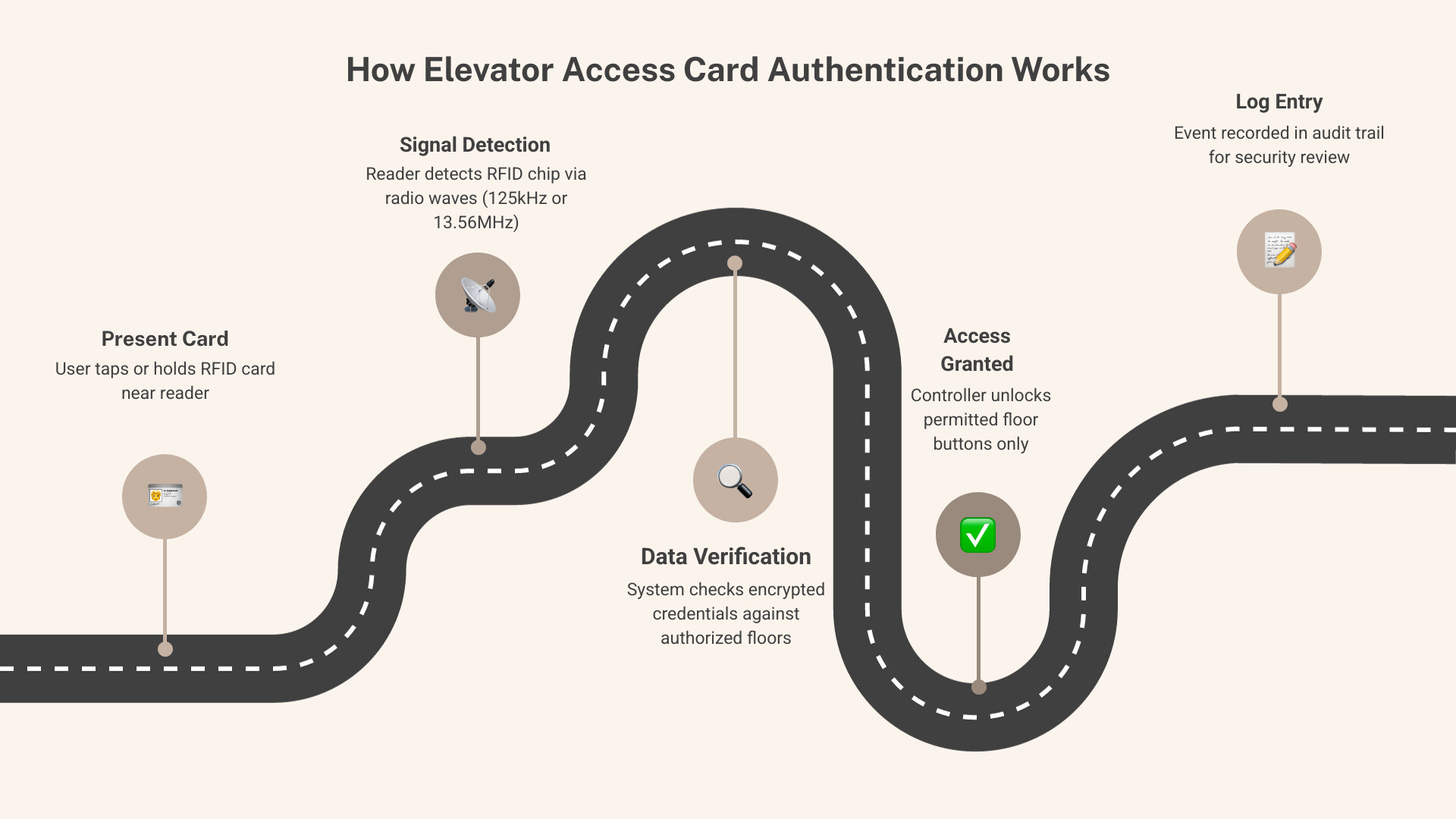
An elevator access card is a small, programmable credential — usually a plastic card or key fob — that uses radio frequency technology to control which floors a person can reach inside a building’s elevator.
Here’s a quick breakdown:
- What it is: A card or fob embedded with an RFID chip and antenna
- How it works: You tap or present the card to a reader; the reader verifies your identity wirelessly and unlocks only the floors you’re permitted to access
- Who uses them: Offices, hotels, hospitals, residential towers, and public transit systems
- Why they matter: They replace physical keys with programmable, revocable digital credentials that log every access event
Buildings across the Gold Coast and beyond are moving away from traditional keys and toward smarter, layered security. And the elevator — often overlooked — is one of the most important access points in any multi-story building.
Think about it. A locked front door means little if anyone can ride the elevator straight to a restricted floor.
That’s exactly why elevator access control has become a core part of modern building security. From high-rise offices to hotel towers, these systems define who goes where, when — and leave a clear record if something goes wrong.
The Evolution of the Elevator Access Card
The journey from the simple mechanical key to the modern elevator access card is a fascinating tale of technological leaps. In the early days, if you wanted to restrict a floor, you needed an elevator operator or a physical lock on the button panel. Today, we live in an era of “contactless” everything.
Modern systems primarily rely on RFID (Radio Frequency Identification). As we move through April 2026, we see a massive shift toward high-frequency systems. While older buildings might still use 125kHz low-frequency cards—which are simple and have a range of 1 to 4 inches—newer installations across the Gold Coast and Northern NSW favor 13.56MHz high-frequency technology, such as Mifare chips.
But the evolution hasn’t stopped at plastic. We are now seeing the rise of BLE (Bluetooth Low Energy) and NFC (Near Field Communication) integration. This allows for mobile credentials, where your smartphone essentially becomes your elevator access card. Imagine walking into a lobby in Burleigh or Miami and having the elevator already “know” you’re there because your Apple Wallet badge communicated with the reader from several feet away.
Leading solutions, such as those discussed in RFID Elevator Access Control Technology, highlight how these embedded readers can integrate with existing infrastructure to provide a seamless “single credential” experience. This means the same badge that gets you through the front turnstile also grants you access to your specific office floor and even the secure printer down the hall.
Enhancing Security with the Elevator Access Card
Why the shift to high-frequency Mifare and smart cards? It all comes down to data and encryption.
- Identity Verification: Unlike a metal key, an RFID card provides unique identity authentication. The system doesn’t just know a key was used; it knows your key was used.
- Contactless Authentication: Especially in high-traffic areas like hospitals or transit hubs, the ability to tap and go reduces wear and tear on hardware and improves hygiene.
- Multi-Level Access: A single card can be programmed with complex permissions. For example, a maintenance worker might have access to every floor, while a specific tenant is restricted to floors 4 and 10.
- Durability: High-quality smart cards are designed for longevity, often supporting up to 100,000 read/write cycles. This makes them incredibly cost-effective for long-term building management.

Key Benefits and Real-World Use Cases
Implementing an elevator access card system isn’t just about keeping people out; it’s about making the building run better. One of the most surprising benefits is energy efficiency. When integrated with hotel management systems, these cards can work with energy-saver switches. Statistics show that such integrations can save up to 40% on energy costs by ensuring lights and climate control only activate when a guest has used their card to reach their room.
In public transit, the benefits are even more practical. Real-world tests in late 2023 showed that limiting elevator access to riders with valid fare cards significantly discouraged misuse and reduced mechanical outages. By ensuring only legitimate users could access the lifts, the elevators stayed cleaner and more reliable for those who truly needed them, such as passengers with disabilities or heavy luggage.
For hospitals and corporate offices, the use case is purely about safety and workflow. Hospitals use these systems to ensure that only authorized medical staff can reach sensitive areas like maternity wards or surgical suites. In a busy office building, it prevents “floor hopping” by visitors who haven’t been checked in at the front desk.
If you are looking to secure a commercial property, exploring Access Control Systems is the first step toward a holistic security strategy. Furthermore, specialized hardware like those found in Elevator Controllers | Vingcard shows how these systems can operate both online and offline, ensuring that even during a network glitch, your building remains secure.
System Configurations and Reader Installation
Setting up an elevator access card system requires careful planning regarding how the hardware is configured. There isn’t a “one size fits all” approach.
Common Configurations
- Single Elevator: The simplest setup where one reader controls one cab.
- Elevator Banks: Multiple elevators working together. These often use a central controller to sync permissions across all cabs.
- Destination Dispatch: This is the “gold standard” of efficiency. Instead of swiping inside the cab, you swipe at a kiosk in the lobby and select your floor. The system then tells you exactly which elevator (A, B, or C) to board. This groups people going to the same floor, reducing travel time.
Reader Types Comparison
| Reader Type | Security Level | Best For |
|---|---|---|
| Proximity (125kHz) | Basic | Small offices, residential low-rise |
| Smart Card (13.56MHz) | High | Hotels, corporate headquarters |
| Biometric (Fingerprint/Face) | Ultra-High | Server rooms, high-security labs |
| Mobile (NFC/BLE) | High / Convenient | Modern co-working spaces, luxury apartments |
Installation Standards
Placement is critical for both security and accessibility. According to ADA (Americans with Disabilities Act) standards, readers should be mounted between 34 and 48 inches above the floor. This ensures that individuals in wheelchairs can easily reach the reader.
In most setups, readers are installed inside the elevator cab near the floor button panel. However, for higher security, they can also be placed outside the elevator near the call buttons. This prevents unauthorized users from even entering the cab in the first place. You can find more on specific hardware options at Card Reader Access Systems: Proximity Cards | LiftMaster.
Security Risks and Management Best Practices
No system is 100% foolproof, and as security experts on the Gold Coast, we’ve seen it all. The most common vulnerability isn’t a “hacker” in a hoodie; it’s tailgating. This happens when an authorized person swipes their elevator access card, and an unauthorized person slips into the elevator behind them.
Another risk is the Fire Service Override. Most elevators have a standard key switch for firefighters. Unfortunately, these keys are often standardized across brands, meaning a motivated intruder could potentially buy a fire key online to bypass the card reader. To combat this, modern systems monitor “Fire Service Mode” with digital alerts that notify security if the system is manually overridden.
Best Practices for Building Managers
- Audit Trails: Regularly review logs to see who is accessing which floors and at what times.
- The 10-Second Window: Most systems give a 10-second window after a card swipe to press a floor button. Keeping this window short prevents “piggybacking” where one swipe allows multiple people to select different floors.
- Remote Revocation: If an employee leaves the company or a guest loses their card, your system should allow you to revoke those privileges instantly from a central dashboard.
- Video Integration: Link your elevator readers to CCTV. If a “denied access” event occurs, the camera should automatically bookmark that footage.
For a deeper dive into technical setup, we recommend reading Mastering Elevator Access Control System Setup.

Preventing Unauthorized Copying of an Elevator Access Card
A common question we get at Palm Beach Locksmiths is: “Can my elevator access card be copied at a kiosk?”
The answer depends on the technology. Older 125kHz cards are relatively easy to clone with cheap devices like the XZCOPY3. This is why we strongly recommend moving to encrypted 13.56MHz smart cards. These use “handshake” protocols and encryption layers that make unauthorized duplication nearly impossible for the average person.
Furthermore, advanced systems feature Blacklist Management. A robust controller can hold a blacklist of up to 1,000 cards. If a card is reported stolen, it is added to the blacklist, and the reader will refuse to even “talk” to it, rendering the card useless even if someone tries to use it.
Frequently Asked Questions about Elevator Access
Can elevator access cards be used in multiple buildings?
Generally, no. Each elevator access card is programmed with a unique site code and user ID specific to one building’s database. While some “universal” cards exist for multi-site corporations, a card from an office in Currumbin won’t work in a residential tower in Tugun unless specifically programmed by the administrators of both systems.
What should I do if I lose my elevator key card?
Notify building management or your security provider immediately. Because these systems are digital, we can deactivate your old card’s ID number in the system and issue a new one. Once deactivated, the lost card becomes nothing more than a useless piece of plastic, protecting the building from unauthorized entry.
Do home elevators require access control systems?
Most residential home elevators do not require an elevator access card because the home itself is secure. However, we do see these systems used in “mixed-use” homes—for example, a property where the ground floor is a business and the upper floors are private living quarters. In these cases, a card reader ensures clients can’t accidentally wander into your living room!
Conclusion
As the skyline of the Gold Coast continues to grow, the humble elevator access card has evolved into a sophisticated guardian of our vertical spaces. Whether you’re managing a luxury resort in Surfers Paradise or a boutique office in Burleigh, the right access control system provides peace of mind, operational efficiency, and a professional image.
At Palm Beach Locksmiths, we’ve spent over 40 years securing the homes and businesses of our local community. From Currumbin to Northern NSW, our 24/7 mobile service team is ready to help you design, install, and maintain the latest in electronic security. Don’t leave your upper floors to chance—let us help you take your building security to the next level.