
What Is a Keying Schedule and Why Does It Matter?
A keying schedule is a structured document that maps out exactly which keys open which locks across a facility — and who has access to what. It forms the backbone of any well-designed master key system.
Quick answer: What does a keying schedule include?
- Which doors and locks exist in the facility
- Which keys operate each lock (change keys, master keys, grand masters)
- Who holds each key and at what access level
- The hierarchy of access — from individual room keys up to a top-level master
- Key symbols and codes used to track and manage the system
Getting this right from the start saves time, money, and security headaches down the track.
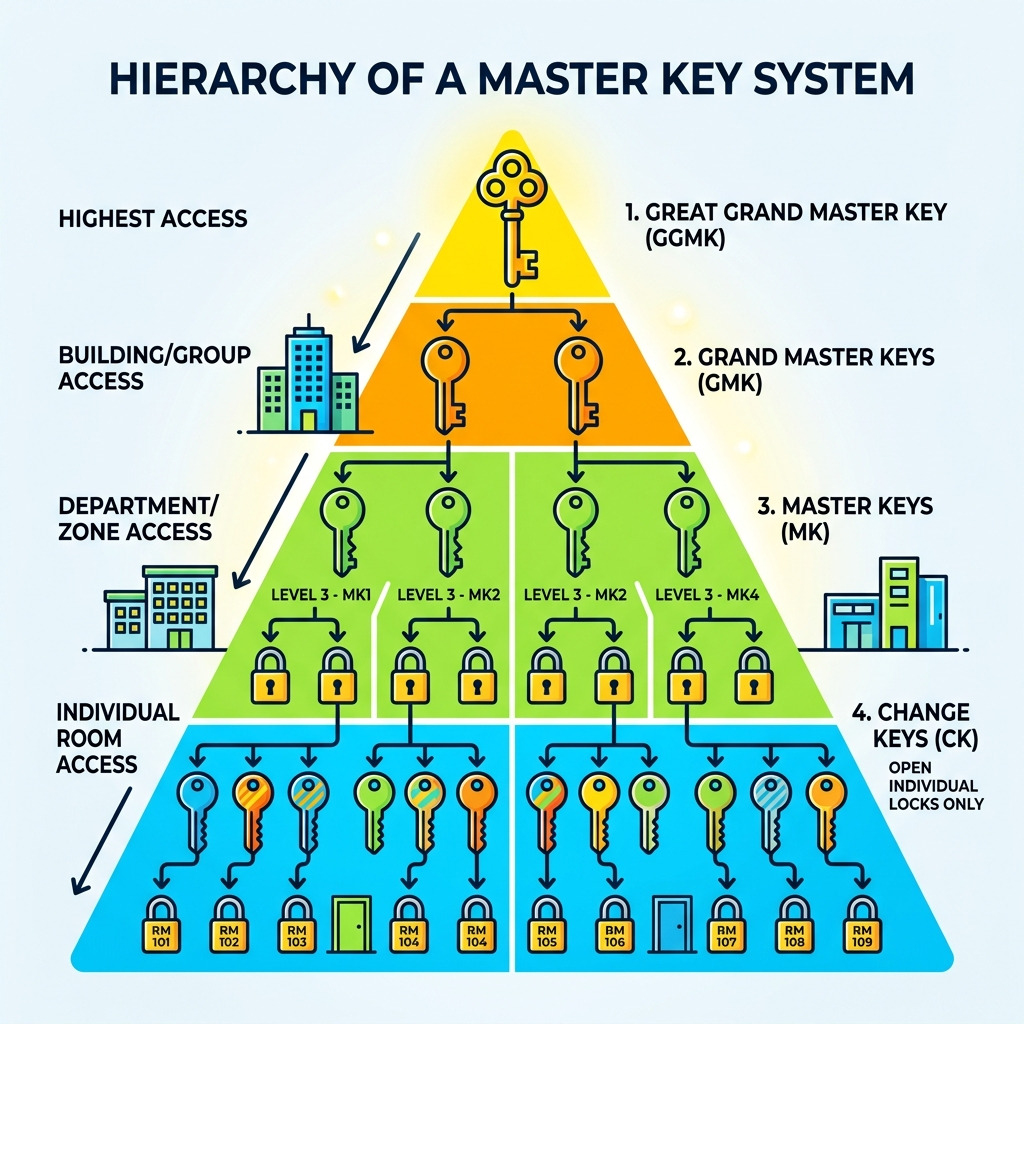
Think of a master key system like an organisational chart. At the bottom are individual keys for single locks. Above those sit master keys covering a department or floor. Higher still are grand master keys for entire buildings — and in the largest facilities, a great grand master key sits at the very top.
A poorly planned system can fall apart fast. Industry experts note that key systems often “disintegrate” when not properly designed from the beginning — leaving facility managers with little choice but to hand out universal master keys to everyone, which defeats the purpose entirely.
Whether you’re managing a small Gold Coast business, a residential complex, or a large commercial facility, understanding your keying schedule is one of the most important security decisions you’ll make.
Understanding the 5 Levels of a Master Keying Schedule
When we sit down to design a keying schedule, we don’t just start cutting keys at random. We follow a strict hierarchy. Most systems fall into one of five levels, depending on how many “layers” of master keys are required.
It is a common industry fact that most master key systems do not actually need more than four levels of keying. In fact, going beyond four levels is generally discouraged because it can compromise the physical security of the lock cylinders.
| Keying Level | Common Name | Typical Application |
|---|---|---|
| Level 1 | Keyed Different / Alike | Small homes, individual shops |
| Level 2 | Master Key System | Apartments, small schools, offices |
| Level 3 | Grand Master Key System | Hospitals, large schools, office blocks |
| Level 4 | Great Grand Master System | Large universities, government complexes |
| Level 5 | Multi-System Complexes | Massive multi-building campuses |
At the base of any system is the Change Key. This is the key that opens one specific lock (or a group of locks keyed alike). As we move up the Master Key System Design – PDQ Locks hierarchy, each subsequent level can open all the locks in the levels below it within its specific branch.
For businesses in Burleigh or Miami looking to secure their premises, choosing the right level is the first step in Commercial Locksmith planning.
When to Use Each Level of Keying
Choosing the right level is about balancing your organizational structure with your security needs.
- Level 1 (No Master Keys): Ideal for a single residence or a small shopfront in Currumbin. You either have one key for every door (Keyed Alike) or a different key for every door (Keyed Different). There is no “overriding” key.
- Level 2 (Master Key): This is the “bread and butter” of restricted key system applications. It’s perfect for a small apartment block where tenants have their own keys, but the manager has one Master Key for maintenance.
- Level 3 (Grand Master Key): This level combines two or more Level 2 systems. Imagine a school where the Science Department has its own Master Key and the English Department has its own, but the Principal has a Grand Master Key that opens everything.
- Level 4 (Great Grand Master Key): This is for massive facilities, like a multi-campus hospital or a large local council building. It provides a very high level of oversight but requires expert planning to ensure the cylinders remain secure.
Determining the Right Level for Your Facility
To pick the right level for your keying schedule, we ask a few vital questions:
- Who needs access? (Janitors, CEOs, IT staff, tenants)
- What is the building’s function? (High-turnover apartments vs. high-security labs)
- What is your plan for the future? A system designed for exactly 10 doors today will be a nightmare when you expand to 15 next year.
We often recommend integrating Access Control Systems alongside physical keys for high-traffic areas to reduce the number of master keys in circulation.
Designing and Laying Out Your Master Key System
Designing a keying schedule is a bit like playing a high-stakes game of Tetris. We start with a comprehensive site survey. This involves walking through the facility and identifying every single door opening—not just the front door, but cupboards, padlocks, and server rooms too.

During this phase, we look at “traffic flow.” How do people move through the building? By mapping this out in a flowchart, we can group locks logically. For example, all exterior doors might be grouped under one sub-master, while all internal offices are under another. This is where Residential Locksmith skills meet commercial engineering.
Using professional Key System Tools / Support | Corbin Russwin ensures that the mathematical logic behind the bittings (the “teeth” on the key) remains sound.
Standard Key Symbols and Coding Conventions
To keep things organized, the industry uses a standardized “language” of symbols. This prevents confusion between the locksmith, the manufacturer, and the facility manager.
- Letters and Numbers: Usually, letters represent master keys (A, B, C), and numbers represent the individual “change” keys under them (A1, A2, B1).
- The “Forbidden” Letters: In a professional keying schedule, the letters I, O, and Q are generally never used. Why? Because they look too much like the numbers 1 and 0, which could lead to a very expensive mistake when cutting keys! This leaves 23 usable letters (A-H, J-P, R-Z).
- Blind Codes: We often use “blind codes” on the keys themselves. Instead of stamping “FRONT DOOR” on a key (which is a huge security risk if you lose it!), we stamp a code like “AA1” that only makes sense when looking at the confidential schedule.
More technical details on how these codes interrelate can be found in the general Key schedule documentation.
Planning for System Expansion in a Keying Schedule
One of the biggest mistakes people make is “over-keying” a system or leaving no room for growth. A keying schedule has mathematical limits. There are only so many ways you can cut a key before it starts accidentally opening another lock in the building.
We use several strategies to prevent this:
- Multiplex Keyways: Think of this like having different “shapes” of keyholes. One shape might be for Building A, and another for Building B. This allows us to repeat the same internal “bittings” without the keys crossing over.
- MACS (Maximum Adjacent Cut Specification): This is a technical rule that prevents us from cutting a very deep notch right next to a very shallow one, which would make the key too weak or cause it to get stuck.
- The “Pie” Analogy: We treat the total number of possible key combinations like a pie. If you take too many big slices (broad master keys) early on, you won’t have any small slices (individual room keys) left for future expansions.
Even in digital cryptography, as seen in the AES key schedule, expansion must be calculated precisely to maintain security—and physical locks are no different.
Best Practices for Security and Key Control
A brilliant keying schedule is useless if you don’t have good “key control.” Key control is the policy of who gets a key, how they are stored, and how they are tracked.
We recommend several best practices for our Gold Coast clients:
- Restrict the “Top” Keys: Only the most trusted personnel should have the Grand Master or Great Grand Master keys. The more of these in circulation, the higher the risk.
- Use Restricted Keyways: These are patented key designs that cannot be duplicated at a local hardware store. Only an authorized locksmith (like us!) can cut them, and only with a signed order from a registered signatory.
- Regular Audits: At least once a year, you should do a “key hook” audit. Do you know where every key is? If a staff member left six months ago and didn’t return their key, it’s time to consider re-keying those specific locks.
For those needing help with these audits, our Locksmith Services Gold Coast team can provide professional assistance.
The Risks of Cross Keying and How to Avoid Them
“Cross keying” is when we set up a lock to be opened by two or more different keys that aren’t part of the same master hierarchy. For example, wanting a doctor’s office key to also open the shared staff kitchen.
While it sounds convenient, cross keying is a security nightmare.
- Shear Line Vulnerabilities: Every time you add a new key to a lock, you add more “pins” or “shear lines” inside the cylinder. This makes the lock much easier to pick and increases the chance of “ghost keys” (random keys that shouldn’t work, but do).
- System Degradation: It eats up the mathematical possibilities of your system, effectively “stretching the rubber band” until it snaps.
As explored in The Key Schedule, complexity in a keying system should be handled through smart design, not through “shortcuts” like cross keying.
Essential Documentation for a Successful Keying Schedule
To keep your system running for 15+ years (which is how long a good system should last), you need perfect documentation. This starts with a Keying Conference. This is a meeting between us and the facility owners to finalize the hierarchy before a single pin is placed in a lock.
The final output should include:
- The Keying Schedule: The “master map” of the system.
- Bitting Charts: The secret mathematical codes for each key.
- Signatory Management: A list of who is authorized to order new keys.
Just as astronomers need a precise Building a Scheduling File in SCHED — NRAO Science Site to manage complex telescope data, a facility manager needs an accurate schedule to manage their security.
Frequently Asked Questions about Keying Schedules
What are the common exceptions to standard keying levels?
Sometimes, a facility needs a “one-off” solution. A common exception is a Single Keyed Cylinder (often for a narcotics cabinet in a hospital) that is completely outside the master key system for maximum security. Another is “omitting levels”—skipping the Master Key level and going straight from Change Keys to a Grand Master to keep the system simpler and more secure.
How do you balance security and convenience in a master key system?
The golden rule is: Security is inversely proportional to convenience. The more doors one key opens, the more convenient it is—but the higher the risk if that key is lost. We balance this by grouping core areas (like all electrical cupboards) together so a technician only needs one key for their specific job, rather than a “skeleton key” for the whole building.
What are the mechanical limitations of a physical key system?
Every cylinder has a finite number of “steps” or “depths” for each pin. This creates a mathematical ceiling. If a system is too complex, we run into “interchange,” where keys start opening doors they aren’t supposed to. Physical wear is also a factor; over time, pins wear down, which is why high-quality restricted systems are a better long-term investment.
Conclusion
A well-planned keying schedule is the difference between a secure, organized facility and a chaotic one where security is constantly compromised. At Palm Beach Locksmiths, we’ve spent over 40 years helping businesses across the Gold Coast, Tweed, and Burleigh design systems that stand the test of time.
Whether you need a simple Level 2 system for a new set of units in Tugun or a complex Level 4 hierarchy for a commercial complex in Elanora, we have the expertise to get it right. The best time to plan your keying system is before the locks are installed.
If you’re ready to secure your property with a professionally designed system, More info about commercial locksmith services is just a click away. Let us help you keep your facility safe, efficient, and under control.